
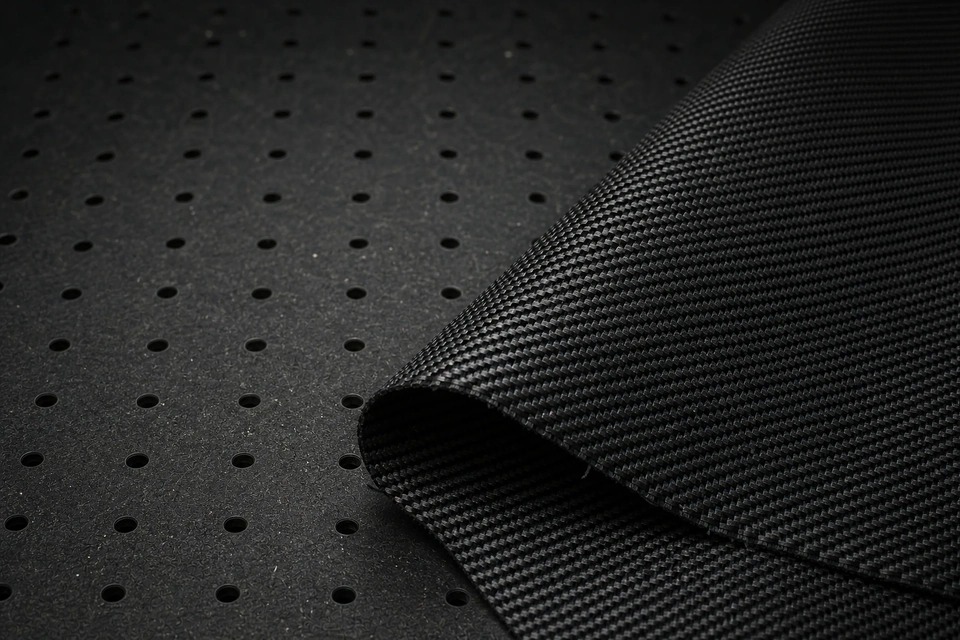
Engineering article
Why fabric follows its shape - and where folds appear
A practical analysis of moulding 200 g/m² carbon fabric: how the fabric bends around the mold, why folds occur, and what data helps check the layup before manufacturing the part.
The shape appears due to shear, not stretching of the fibers
When the fabric is laid on a three-dimensional mould surface, the warp and weft threads hardly elongate. The geometry of the weaving cell changes: the rectangle gradually turns into a rhombus, and the bundles rotate relative to each other. It is this intrastructural shift that allows the fabric to undergo double curvature. Research into moulding mechanics shows that fabric behavior cannot be described by a single tensile test: shear, in-plane and out-of-plane bending, and bundle torsion work simultaneously.
Why neat fabric suddenly bunches up
The available shear is not infinite. The more the angle between the warp and the weft changes, the more closely adjacent bundles come together and the higher the resistance to further laying. After a certain point, the excess length is no longer distributed over the surface and leaves the plane in the form of a wave. Therefore, a fold usually does not indicate a “bad fabric”, but a conflict between the geometry of the part, the cutting direction, the laying path and the method of fixation. Moving the cutting line or rotating the fabric can do more than trying to press the material harder.
What does a density of 200 g/m² and 3K Twill weave give?
This class of material is suitable where you need to combine a readable 3K structure, a relatively thin layer and the ability to conform to the geometry. But the number 200 g/m² does not determine the properties of the finished part in itself. The result depends on the orientation of each layer, resin system, fiber proportion, compaction and curing mode. Twill helps the fabric redistribute geometry during laying, but does not cancel test laying on real equipment if the part has small radii, deep transitions, internal corners or a sharp change in section.
How to prepare a request to check the formability before the series
For engineering selection, it is most useful to convey an image or model of the surface, mark the presentation face and show the expected direction of the pattern. Separately, it is worth indicating the areas where folding is unacceptable, acceptable overlaps and the moulding method. If the geometry is complex, a reasonable next step is a trial lay-up or a process trial. Such a check does not replace the calculation of the laminate, but it reveals early a conflict between the material and the shape and helps to coordinate the cutting before the entire set of blanks is made.