
Engineering article
The weaving is visible from the outside, but it works inside the laminate
Why is it not only the surface texture that is important in 240 g/m² fabric: the architecture of the weave affects laying, load transfer and damage development in the laminate.
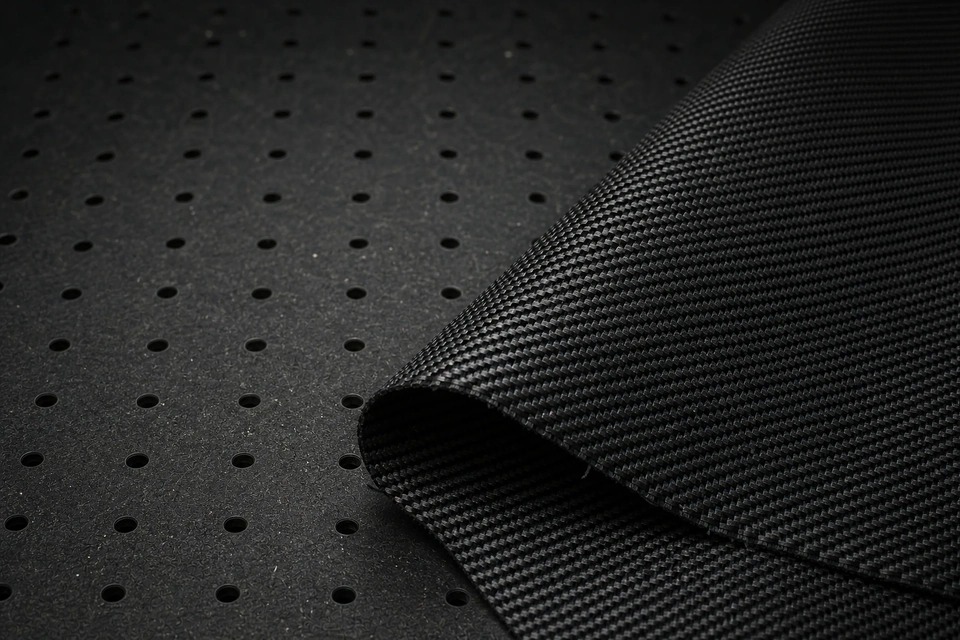
Twill pattern is the geometry of the reinforcement
The twill pattern is highly visible on the finished piece, so it is often thought of as an appearance choice. In reality, the weave determines the path of the yarns: where they pass over adjacent strands, how they bend, and how freely they move as they are formed. This geometry is maintained within the laminate and influences how load transfers between the fibers and the resin system. Therefore, the same 3K and 240gsm designations do not make two fabrics interchangeable without checking the weave, width, finish and process.
Plain and Twill start to get damaged differently
In a published comparison of Plain carbon fabrics and two Twill variants, samples were tested under monotonic and cyclic stretch. The work links differences in mechanical response and damage development specifically to fabric architecture. The practical point is not to declare one weave universally superior. Plain gives more frequent weaves and better fixes the geometry of the fabric; Twill allows for a longer beam pass and generally follows a difficult surface more easily. The decision depends on the shape, direction of the load and the requirements for the presentation face.
Where 240gsm becomes a meaningful choice
Areal weight helps estimate how much reinforcement one layer adds, but does not tell the thickness of the finished panel with the required accuracy. The number of layers, their orientation, the proportion of resin, and the actual compaction are all important to the part. Fabric 240 g/m² can be a convenient intermediate option when a layer of 200 g/m² takes up the package too slowly, and heavy fabric already roughly repeats local transitions. This is a process choice that should be verified in conjunction with the laminate design and is not a separate guarantee of stiffness or strength.
What data do you need to make guess-free choices?
The application should indicate the geometry of the product, the working load, the direction of the main forces and the requirements for the visible surface. For a visible surface, it is important to agree in advance on the orientation of the Twill, the position of the seam, and the tolerance of tuft displacement. For a load-bearing part, you additionally need a layer diagram or initial data for its selection. If vacuum infusion, hand layup or a prepreg process is planned, this should also be noted: the same fabric behaves differently during fixation, impregnation and compaction.