
Engineering article
Thin sheet and clean hole: why support is needed
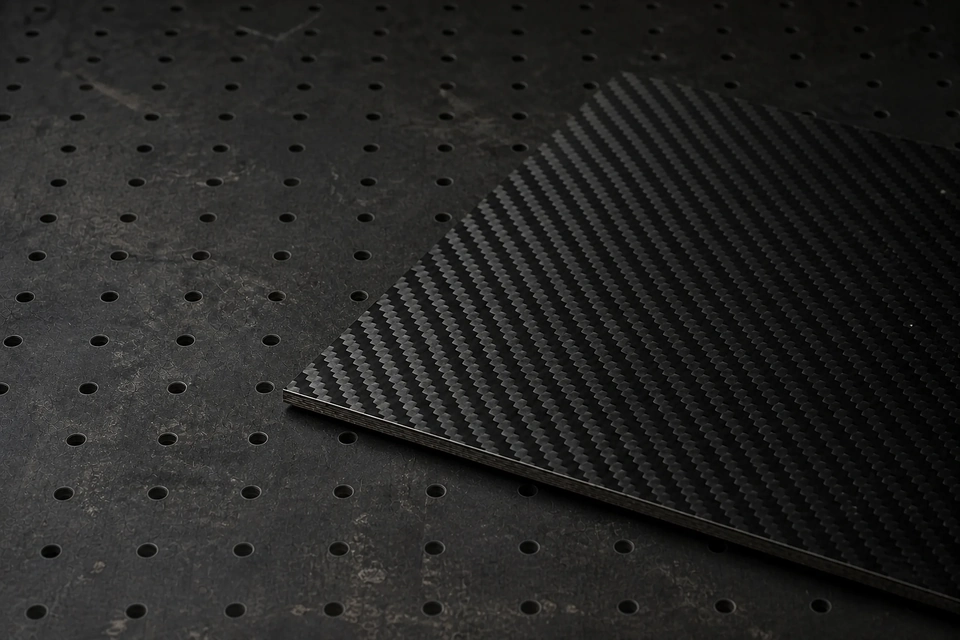
A thin carbon fibre sheet requires careful support and machining: where does the damage come from at the hole and what data helps to obtain a clean edge.
One millimeter does not forgive extra effort
The thin sheet appears to be an easy material to cut, but its low thickness makes it susceptible to bending during machining. If the blank is poorly supported, the axial force of the tool will bend it before the cutting edge has completely removed material. In a multi-layer composite, this deflection can push the layers apart at the entrance or exit of a hole. Therefore, a rigid, level substrate, reliable fixation and lack of vibration are part of the technology, and not auxiliary conveniences for the operator.
Why is drilling mode related to edge condition?
Experimental work on CFRP drilling relates damage to feed, axial force, and support conditions. A worn edge begins to put more pressure and heat the material; overfeeding increases the mechanical stress on the underlying layers. But there is no universal mode for any sheet: the result depends on the laying, resin system, diameter and requirements for the part. The correct approach is to assign a tool and mode for a specific operation, and for a series, confirm them on a trial sample.
Clean part starts before machine starts
The cutting file must have closed contours, clear dimensions and agreed upon minimum radii. In a separate PDF it is useful to note the face, bases, critical holes and edges that are involved in the assembly. If the surface must remain decorative, the fixation method is also chosen taking into account traces. For small parts, it is important to check the distance from the hole to the edge: even a careful cut will not compensate for geometry in which there is too little material left around the fastener.
What to clarify when ordering a sheet or ready-made cutting
For the sheet, indicate the format, quantity, requirement for surface pattern and acceptability of protective film. For finished part, please attach DXF or STEP and reference PDF with units, thickness and tolerances. Separately list openings where clean exit is important and indicate whether the edge will be visible. Availability refers to the specific stock entry on the verification date; price is confirmed with your enquiry; data sheet, certificate or photographs of the batch are provided only after confirmation of the relevant document and must be explicitly requested before delivery is agreed.